How Shared Time on the Water in Marina del Rey Builds Deeper Connection
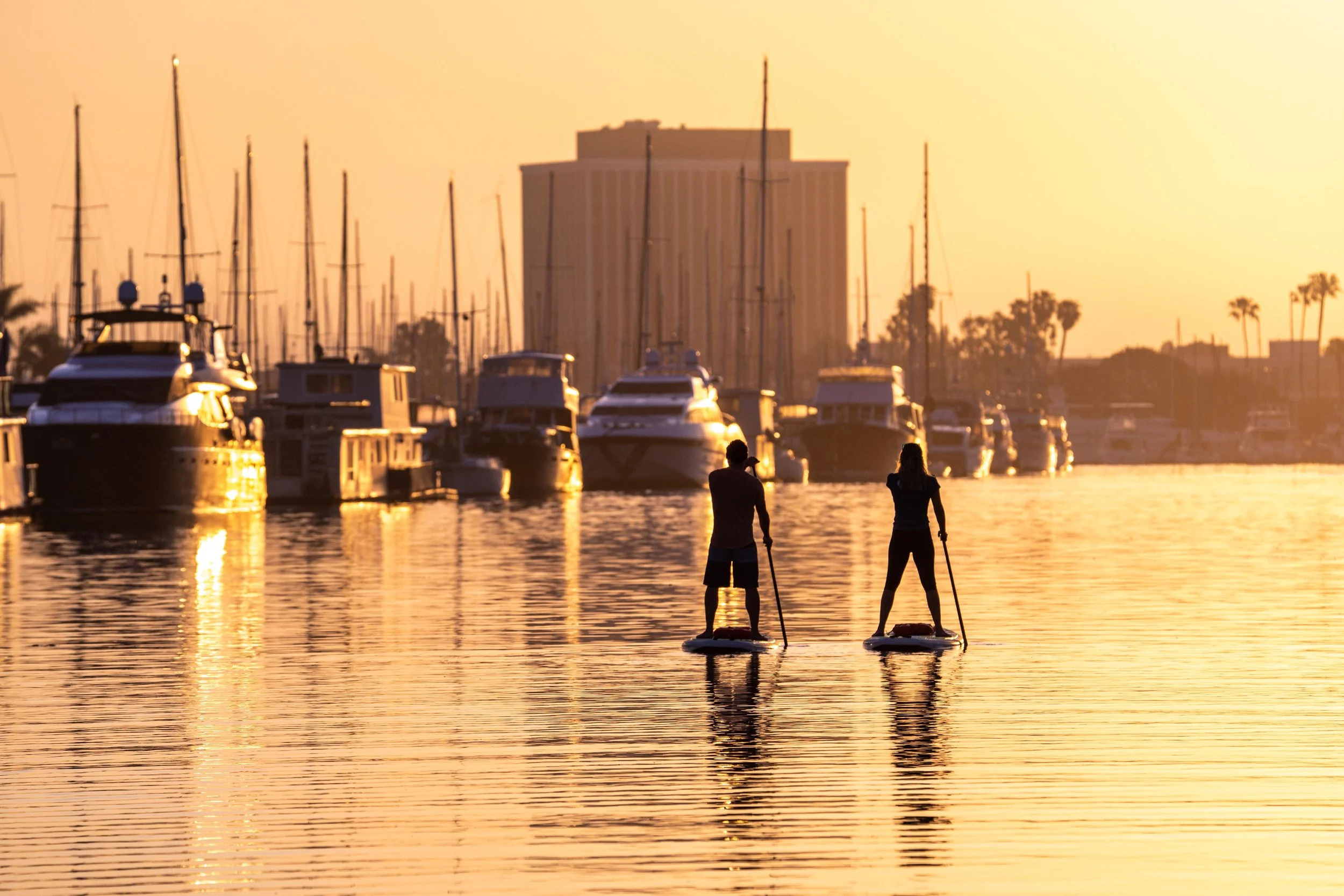
Photo above by Brandon Kirk
“The Perfect Date” & What We’re Really Seeking
February brings a familiar question to the surface. What is it that makes a date meaningful? As Valentine’s Day approaches, the focus often drifts toward planning, presentation, and performance. Yet research across psychology, neuroscience, and environmental design reveals connection strengthens through shared experience, shared movement, and settings that lower social pressure.
Where Shared Movement Creates Real Rapport
Studies on experiential connection consistently show that intimacy forms less through constant conversation and more through shared physiological states. Wallace J. Nichols’ Blue Mind framework describes how proximity to water shifts the brain away from high-alert “red mind” states toward calmer, more open patterns of attention, sometimes called “soft fascination.” In this state, the prefrontal cortex relaxes its grip, making empathy and openness easier to access (Nichols, 2014; Resurgence Trust, “Soft Fascination”).
When two people paddle together, the environment and the movement work in tandem. The steady, bilateral motion of paddling provides rhythmic input that supports nervous system regulation. Research on biorhythmic movement and polyvagal theory, developed by Dr. Stephen Porges, shows that rhythmic, low-intensity movement supports a ventral vagal state associated with safety and social engagement. This physiological shift makes trust and rapport more likely to develop, not because anyone tries harder, but because the body feels safe enough to be present (Porges, Polyvagal Theory; Live Fit Gym, “How Biorhythmic Movement Heals Trauma Through Motion”).
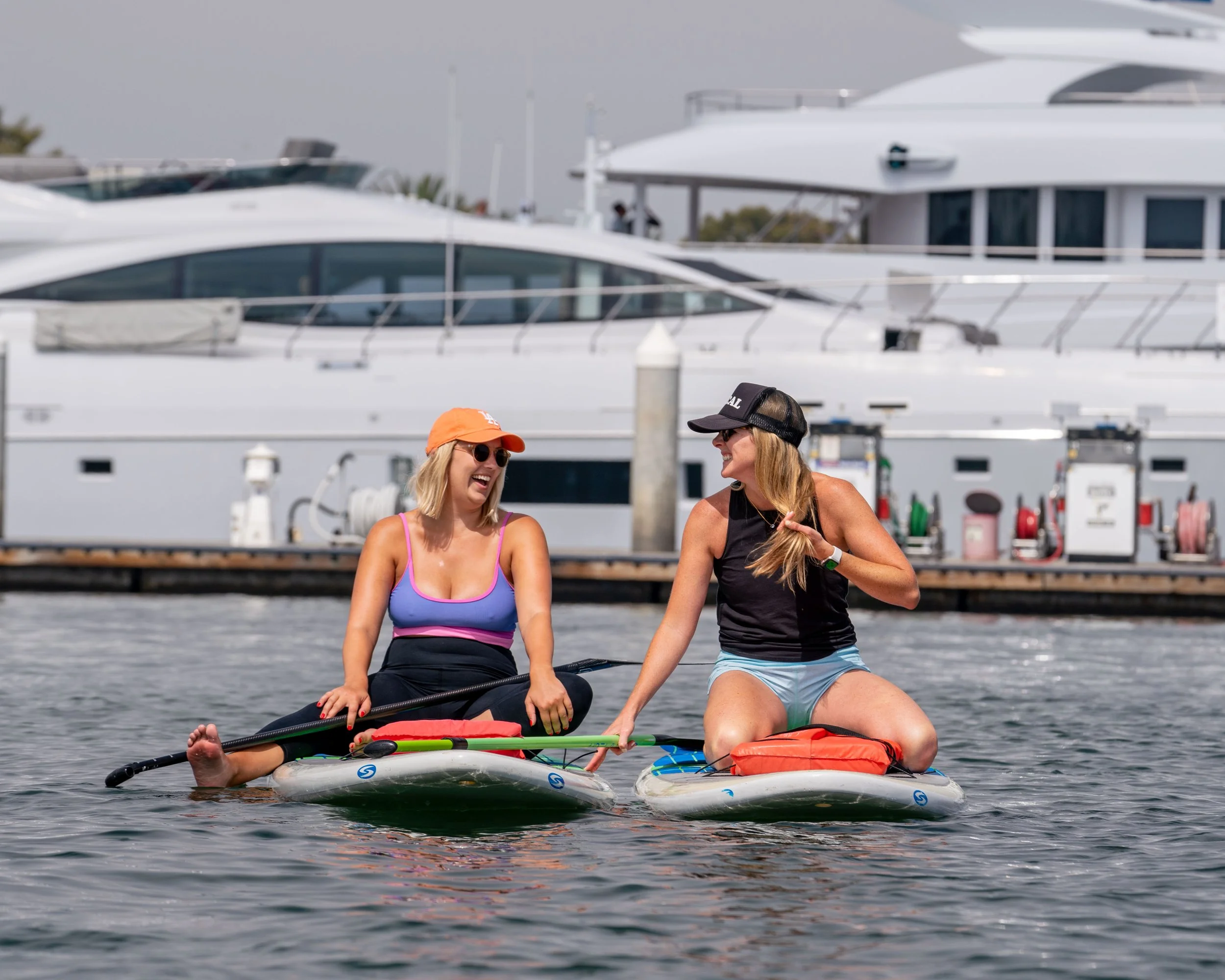
Photo below by Brandon Kirk
Why Side-by-Side Experiences Feel Different
Connection also changes when people move side by side rather than face to face. Social psychology research on parallel interaction shows that shared orientation toward a horizon reduces self-monitoring and social evaluation. Studies summarized in Psychology Today and The Economic Times report that people speak more freely and disclose more honestly when walking or moving alongside one another, compared to seated, face-to-face settings that subtly increase cognitive load and self-awareness.
On the water, this dynamic becomes tangible. Two boards or kayaks glide in the same direction. Attention shifts outward and conversation unfolds naturally, with pauses that feel comfortable rather than awkward. Trust grows as a result of shared pace and shared focus, not forced intimacy (Leggggs, “The Science of Side-by-Side”; Frontiers in Psychology, research on interpersonal synchrony).
When Calm Water Matters
Environment plays a decisive role. Research on blue spaces shows that protected, flat-water environments support attentional restoration and emotional openness more effectively than unpredictable settings. The Marina del Rey harbor, particularly around Mother’s Beach, functions as a low-pressure aquatic space. No surf, minimal currents, and long sightlines allow beginners and experienced paddlers alike to stay oriented to the experience rather than having to manage risk
In Marina del Rey, the harbor’s calm conditions create room for shared observation. Wildlife sightings, shifting light on the water, and the quiet rhythm of paddles dipping all provide what researchers call “joint attention,” a foundational building block of social bonding. Studies published in Psychological Science and Frontiers in Psychology show that simply attending to the same external stimulus increases feelings of closeness and perceived similarity, even without explicit shared goals.
Your February, Reimagined
Cultural research suggests that many people are quietly stepping away from high-pressure Valentine’s traditions. Consumer studies from Lightspeed Commerce and Retail Insider indicate a growing preference for experiences that emphasize presence, wellness, and time together over performative gestures. Short, repeatable experiences, sometimes called “micro-dates,” tend to support relationship satisfaction more effectively than one-off, high-stakes events.
A paddle on calm water fits this shift. It offers movement without intensity, closeness without demand, and time that feels expansive rather than scheduled. The experience becomes part of a shared story, something remembered and revisited rather than consumed and forgotten. Research by Gilovich and Kumar on experiential versus material purchases shows that experiences generate longer-lasting satisfaction and stronger social bonds than physical gifts, largely because they become woven into personal and relational identity (Gilovich & Kumar, Psychological Science).
An Invitation to Share the Water
All month long, we are keeping that invitation open.
Throughout February, our BOGO Buy One, Get One offer is running on paddleboard and kayak rentals. Bring your paddle buddy or invite someone you want more time with. Share the water, side by side, and let shared movement do what it has always done best.
Flat water. Easy access. It’s on!
-
Shared experiences create connection through participation rather than performance. Research in psychology and neuroscience shows that moving together in a calm environment supports trust, rapport, and emotional openness more effectively than high-pressure, face-to-face settings. When people engage in a shared activity, attention shifts outward, social self-monitoring decreases, and connection develops through rhythm and presence instead of conversation alone.
-
Water environments naturally reduce cognitive load and stress. Studies on “blue spaces” show that proximity to water promotes calm, attentional restoration, and emotional openness. When combined with gentle movement, like paddling, the nervous system enters a state that supports social engagement, making it easier for people to relax, listen, and connect.
-
Yes. Calm, flat-water environments like Marina del Rey are especially well-suited for beginners. Beach entry, protected harbors, and minimal currents allow people to focus on the shared experience rather than managing balance or conditions. This makes paddling accessible even for first-timers and helps keep the experience low-pressure and enjoyable.
-
Social psychology research shows that side-by-side orientation reduces self-consciousness and social evaluation. When people move in the same direction and focus on a shared horizon, conversation tends to flow more naturally. This dynamic often leads to more honest communication and comfortable pauses, which are important for building trust and rapport.
-
Not at all. While many people think about Valentine’s Day in romantic terms, shared time on the water supports connection across all kinds of relationships. Friends, siblings, parents and adult children, and even coworkers often find that paddling together creates meaningful shared moments without the pressure of forced intimacy.
-
February often brings quieter conditions, calmer water, and fewer crowds in the harbor. This creates a more spacious, relaxed atmosphere that supports presence and connection. Many people also use this time of year to seek experiences that feel grounding and restorative, making it an ideal season for shared movement on the water.
-
Throughout February, we are offering a Buy One, Get One deal on paddleboard and kayak rentals. When you rent one board or kayak, the second is included, making it easy to bring a paddle buddy or invite someone you want more time with.
-
Bring someone you enjoy spending time with or someone you’d like to connect with more deeply. A partner, a friend, a family member, or even someone new to paddling. The experience works best when it’s shared.
-
You can book directly through our website. Select your paddleboard or kayak rental, and the Buy One, Get One offer will apply throughout February.
Article Sources
Blue Mind, Water, and Environmental Psychology
Wallace J. Nichols – Blue Mind framework
Psychology of Water: Health & Culture
https://integritypools.org/psychology-of-water
Soft Fascination & Attentional Restoration
Soft Fascination – The Resurgence Trust
https://www.resurgence.org/magazine/article6071-soft-fascination.html
The therapeutic power of blue space – Mental Health Commission of Canada
https://mentalhealthcommission.ca/society/pwlle/the-therapeutic-power-of-blue-space/
Nature and mental health (peer-reviewed)
The great outdoors: mental health benefits of natural environments (PMC)
https://pmc.ncbi.nlm.nih.gov/articles/PMC4204431/
Nervous System Regulation, Rhythm, and Polyvagal Theory
Movement and nervous system regulation
How Movement Can Support Nervous System Regulation – Tidal Trauma Centre
https://tidaltrauma.com/blog/movement-nervous-system-regulation
Biorhythmic movement and regulation
How Biorhythmic Movement Heals Trauma Through Motion – Live Fit Gym
https://livefitgym.com/how-biorhythmic-movement-heals-trauma-through-motion-flow-to-freedom/
Polyvagal Theory (Stephen Porges)
Polyvagal Theory Utility in Pediatric OT
https://www.occupationaltherapy.com/articles/polyvagal-theory-utility-in-pediatric-5797
Side-by-Side Interaction, Synchrony, and Disclosure
Why people talk more side by side
Psychology explains why people talk more when walking side by side – Economic Times
https://m.economictimes.com/us/life/psychology-explains-why-people-talk-more-when-walking-side-by-side/articleshow/127857908.cms
The science of side-by-side honesty – Leggggs
https://leggggs.com/2023/04/18/the-science-of-side-by-side/
Face-to-face vs parallel orientation
Why you stand side-by-side or face-to-face – Psychology Today
https://www.psychologytoday.com/za/blog/he-speaks-she-speaks/201404/why-you-stand-side-by-side-or-face-to-face
Gaze, evaluation, and cognitive load
How gaze supports face-to-face interaction (PMC)
https://pmc.ncbi.nlm.nih.gov/articles/PMC7547045/
Synchrony, Joint Action, and Brain-to-Brain Coupling
Behavioral and neural synchrony
Rhythm in joint action (PMC)
https://pmc.ncbi.nlm.nih.gov/articles/PMC4240961/
Brain-to-brain synchrony
Synchrony across brains (PMC)
https://pmc.ncbi.nlm.nih.gov/articles/PMC12668431/
Face-to-face vs screens: neuroscience of real connection
https://microage.com/culture/face-to-face-vs-screens-what-neuroscience-reveals-about-real-connection/
Joint Attention and Social Bonding
Foundational joint attention research
Attention, joint attention, and social cognition (PMC)
https://pmc.ncbi.nlm.nih.gov/articles/PMC2663908/
Joint attention and bonding
Joint attention, shared goals, and social bonding (PMC)
https://pmc.ncbi.nlm.nih.gov/articles/PMC4849556/
Experiential vs Material Purchases (Gilovich & Kumar)
Why experiences create stronger bonds
Experiences make people happier than material goods – ScienceDaily
https://www.sciencedaily.com/releases/2004/12/041219182811.htm
Story utility & experiential memory
Some “Thing” to Talk About? Differential Story Utility (Amit Kumar & Thomas Gilovich)
http://www.kumar-amit.com/s/Kumar-Gilovich-in-press-Some-Thing-to-Talk-About-PSPB.pdf
Material vs experiential purchases
The relative relativity of material and experiential purchases – ResearchGate
https://www.researchgate.net/publication/40869028_The_Relative_Relativity_of_Material_and_Experiential_Purchases
Valentine’s Day Cultural Shift & February Behavior
Intentional Valentine’s trends
Consumers approaching Valentine’s Day comfortably and intentionally – Retail Insider
https://retail-insider.com/retail-insider/2026/02/consumers-approaching-valentines-day-comfortably-and-intentionally-lightspeed-commerce/
Valentine’s Month & micro-dates
Make Valentine’s Month 2026 one to remember
https://cupla.app/blog/valentines-month-2026/
Researched and created by Coral Hine through a human-guided, Authentic AI System to help you explore the benefits of calm-water movement and deepen your connection to the Marina del Rey community.
